



Electricity will continue to play a central role in enabling a cleaner energy future, yet reliable and affordable power does not occur by chance. It requires careful, deliberate planning to determine when, where, and what types of new power stations should be built.
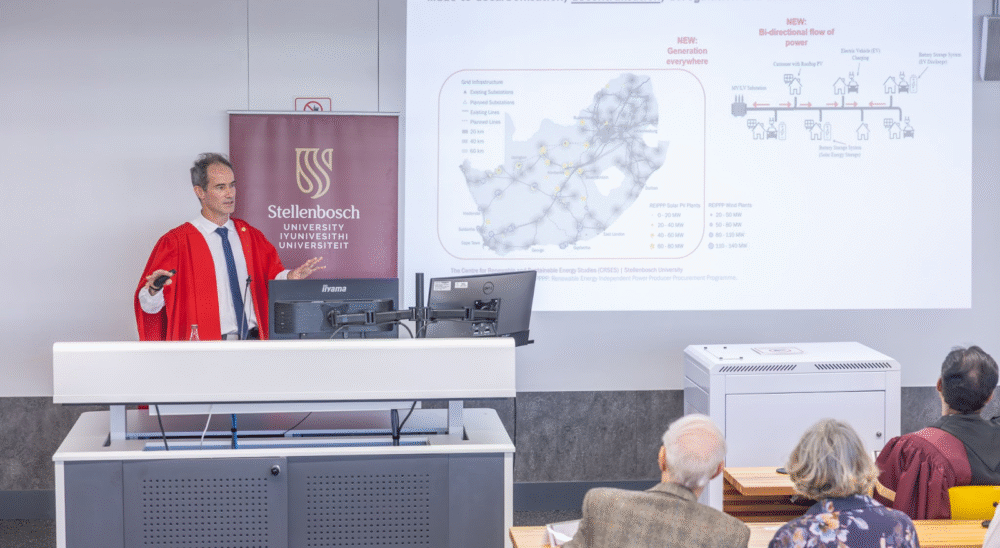
When planning is delayed or poorly informed, the consequences are severe. South Africa’s recent history of loadshedding and rising electricity costs illustrates this clearly. On Thursday, 6 November 2025, Professor Bernard Bekker addressed these complexities in his inaugural lecture, titled “It Depends”: Using Models to Support South Africa’s Future Electricity System.
Professor Bekker, who holds the NRF SARChI Chair in Power Systems Simulation within the Department of Electrical and Electronic Engineering, explores a fundamental difficulty in modern engineering: planning for the unknown.
The Complexity of a Modern Grid
Planning for the future is inherently challenging. It becomes even more complex as electricity networks worldwide integrate large amounts of battery storage and variable renewable energy sources, such as wind and solar. Simultaneously, the liberalisation of electricity markets adds further layers of uncertainty.
In the past, a planner might have asked a simple question and received a definitive answer. Today, the answer is almost always, “It depends.” This is not an evasion but an acknowledgement of the variables at play. To manage this, Professor Bekker focuses on electrical power system planning and operation under uncertainty.
His research uses models to inform these decisions. Models serve as simplifications of reality that allow researchers to simulate possible futures. By doing so, they provide decision-makers in government and industry with better information about the potential outcomes of their choices.
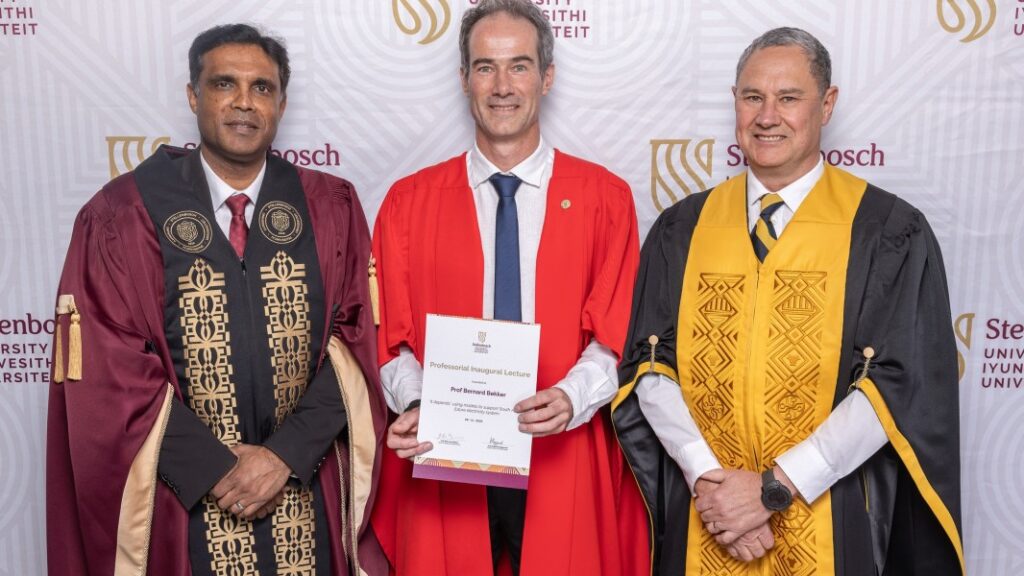
Image: Professor Bernard Bekker (middle) with Rector and Vice-Chancellor, Professor Deresh Ramjugernath (left), and Professor Wikus van Niekerk, Dean of Engineering at Stellenbosch University (right).
Confronting Hard Questions
In his lecture, Professor Bekker used these modeling insights to examine uncomfortable questions that South Africans frequently ask. Will loadshedding return? Could blackouts replace loadshedding as the grid absorbs more wind and solar power? He also addressed the economics of personal power generation, asking if rooftop solar systems are effectively being subsidised by users who remain fully dependent on the grid.
These are not theoretical musings. They are practical inquiries that impact national policy and household budgets. Professor Bekker’s work clarifies which controllable factors have the greatest impact on future risks.
From Banking to Green Energy
A diverse professional background shapes Professor Bekker’s perspective. Originally trained as an electronic engineer, he worked in the banking sector as a systems and network analyst. He later redirected his career toward two of his passions: green building and renewable energy.
After serving in various roles in the solar photovoltaic and power electronics industries, he joined Stellenbosch University in 2017. This blend of financial systems analysis and practical renewable energy experience allows him to view the grid not just as a collection of wires, but as a complex system of assets and liabilities.
The Role of Academia in Decision Making
Models alone do not improve planning outcomes. Furthermore, academia does not make the decisions that shape South Africa’s electricity future. Decision-makers in government and utilities hold that responsibility.
However, Professor Bekker argues that academia plays a vital role in making sure those decisions are informed, transparent, and in the public interest. Academic research serves as an unbiased voice in the public electricity planning debate. It can highlight incorrect storylines and build confidence in necessary innovations.
One of Professor Bekker’s primary activities at the University is capacity building. Through postgraduate supervision and the presentation of industry-focused short courses, he helps develop the next generation of engineers. These are the professionals who will eventually manage the grid, using the very models Professor Bekker champions to keep the lights on in an uncertain future.
Read the full editorial: https://www.su.ac.za/en/faculties/medicine/news/prof-bernard-bekker-wants-help-plan-sas-future-power-system
Watch Professor Bekker’s lecture: https://www.youtube.com/live/h_P3L1btxyQ?si=wAHOASMLP2goMP9J